The Swiss Army Knife Approach to Grief Support: Why One Size Never Fits All
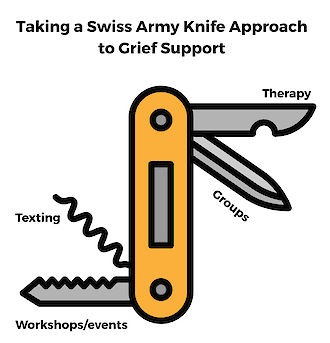
When someone you care about needs to open a bottle, tighten a screw, or cut a thread, you don't hand them a single tool and hope it works. You offer options. A Swiss Army knife succeeds not because any single blade is perfect, but because it provides the right tool for the moment at hand.
Grief support organizations should adopt this same philosophy.
The Limitations of Traditional Approaches
For decades, the grief support field has operated with a limited toolkit. When someone experiences loss, we typically offer two primary support options: individual therapy or support groups. These approaches are valuable and evidence-based, but they're not for everyone.
The 55-year-old man who recently had a parent die most likely won't attend therapy. The 70-year-old widow living in a rural community may not want to drive at night or may not even have access to a grief counselor within 50 miles. The Spanish-speaking mother whose child died traumatically may not be able to find culturally responsive care. The sandwich generation, juggling work, family, caregiving, and loss, probably doesn't have time for weekly appointments.
And yet, we continue to measure our success by the number of people we can funnel into these two traditional modalities. When people don't engage, we label them as "resistant" or "not ready" rather than acknowledging that our limited menu of options simply may not meet their needs.
A Public Health Approach to Grief Care
Adopting a Swiss Army knife approach means embracing a public health approach to grief care (Aoun et al., 2012) that recognizes different levels of need and different points of entry:
Level 0: Grief Literacy and Awareness - Educational materials, community awareness, and preventive resources that normalize grief and provide foundational information. This is where everyone starts. (100% of the population)
Level 1: General Support & Information - Self-paced resources, educational workshops, and technology-based support (such as texting) that provide structure without requiring intensive clinical involvement. (60% of the grieving population)
Level 2: Extra Support - Support groups and short-term peer counseling that provide higher levels of support with some clinical oversight. (30% of the grieving population)
Level 3: Intensive Specialized Care - Individual therapy for those with complex grief, suicidal ideation, or co-occurring conditions. (10% of the grieving population)
For years, funding has been focused on level 2-3 care, where only 10-30% of people fall. This means that very little funding has been focused on supporting the majority of grieving people.
The Underutilized Power of Text-Based Support
There's a critical tool missing from most organizations' kits, one that research data and real-world adoption across 61 countries show to be profoundly effective at reaching populations who don't utilize other forms of support.
Text-based grief support is emerging as one of the most impactful and cost-effective interventions available, and yet it remains vastly underutilized in the grief support landscape. In addition to traditional programs such as newsletters, virtual groups, and memorial events, comprehensive grief support programs should include accessible, multilingual, clinically approved text support.
Consider what we know about hard-to-reach populations:
Men represent one of the most underserved demographics in grief care. Men rarely attend support groups and often drop out of therapy - in fact, a recent study showed the overall dropout rate from therapy was 44.8%, of which 26.6% accessed therapy once and did not return (Seidler et al., 2021). But when men engage with text-based support, most complete a full year of support, and the response is powerful. Geoff, aged 47, who is grieving the death of his father, Gary, shared:
"I love the appropriate timing of the texts- they arrive during the waves of grief and provide simple, easy-to-follow instructions."
Older adults over 65 often face mobility challenges, transportation barriers, and generational stigma around mental health services. Joseph, a 70-year-old man whose wife, Mary, died from cancer, wrote:
"The encouragement is helping with my journey when I feel very low. This grief I am experiencing has been the most difficult experience of my 70 years of life. I am forever grateful. I appreciate the texts with my wife’s name included. It feels very personal. Please don't stop sending texts. I need all the help I can receive."
Rural populations face geographic isolation and limited access to specialized grief services. Text-based support transcends these barriers entirely. After losing her husband, Pete, of 55 years, Lynne shared,
"I am depressed and anxious, after three years of losing him. I am still not finding much success in getting support- I'd like to have a grief group near me. But there are none."
Non-English speakers encounter language barriers that prevent access to culturally responsive care. Text-based programs can deliver support in 28 languages, meeting people in their native tongue. Maria, a mother whose child Josue died, receives her support in Spanish. She shared:
"Me ha ayudado a trasformar la pérdida de Josue. No tuve elección sobre la muerte de mi hijo. Estoy aprendiendo a tener opciones dentro de mi dolor. Puedo elegir vivir mi vida en duelo perpetuo por mi hijo . O, por muy difícil que pueda parecerle en este momento, puedo optar por vivir una vida ahora diferente —pero vivirla plenamente, manteniendo vivos los recuerdos de Josue y las lecciones que, por muy larga o corta que haya sido la vida de mi hijo, aprendí de él. Vivir mi vida de esa manera será un tributo a mi hijo."
Translation: "It has helped me transform the loss of Josue. I had no choice about my son's death. I am learning to have choices within my grief. I can choose to live my life in perpetual mourning for my son. Or, as difficult as it may seem right now, I can choose to live a different life now—but live it fully, keeping alive the memories of Josue and the lessons I learned from him, however long or short his life may have been. Living my life that way will be a tribute to my son."
Traumatic loss survivors often find that well-meaning support falls short of understanding their unique experience. One of our subscribers, Christine, whose 12-year-old son Joseph died by suicide after extensive bullying, shared:
"The texts always seem to come exactly when I need them. I love all the messages. They have been very fitting. I can read them over and over. They are always there to reference back to or show someone else. I like that I could read it whenever I wanted to, and it was always there. It also has reached my soul in ways no one else could. The texts speak to my situation that most people just don't understand. I look forward to this so much. It's been a lifeline to me. I'm so thankful. Please don't stop. It has been a huge help."
Cultural stigma can prevent people from seeking out traditional forms of support. Texting is a private way to seek support. One of our subscribers, a sandwich generation adult caregiver daughter, Sherry-Ann, grieving her 70 y/o father, Grafton, shared:
"Getting support for grief is not something that we actively seek out in my culture. It is not spoken of. You just go on with your life as usual. I know that is not healthy and chose to break the cycle and seek help for myself. The messages allowed me to grieve MY WAY! Without outside interference!"
Why Text-Based Support Works
Text-based grief support succeeds because it addresses barriers that keep people from engaging with traditional services:
- Privacy: No one needs to know you're receiving support
- Accessibility: Works across geography, mobility limitations, and scheduling constraints
- Personalization: Messages can be tailored to loss type, relationship, and timeline
- Control: Grievers read and re-read messages when they're ready
- Low-barrier entry: No appointment scheduling, no commitment to showing up weekly, no pressure to respond, you just receive
- Scalability: Reaches thousands at a fraction of the cost of one-on-one counseling
- Persistence: Messages provide support for as long as you need, whether it's for 6 months, 1 year, or 3 years
The Case for Comprehensive Care
Grief is not uniform, timing is not linear, and what helps one person at three weeks post-loss may be completely different from what another person needs at three years. We need a Swiss Army Knife approach that provides different modalities for different grieving styles and needs.
Someone might need Level 1 support immediately after a loss (texting and education), Level 2 support (support groups) during the first year, and then Level 3 support (therapy) later on. Or they might only ever need Levels 1 and 2, and that's okay. The goal isn't to move everyone up the ladder of intensity. The goal is to meet people where they are and provide access to support that fits their actual needs, when they need it.
Moving Forward
If your mission is to provide meaningful grief support and reduce isolation, ask yourself: Does our programming reflect the diversity of our community's needs? Are we offering tools that work for the 55-year-old man who won't come to a support group? The 70-year-old widow who lives an hour from the nearest therapist? The Spanish-speaking parent who needs culturally attuned care?
If text-based support isn't part of your Swiss Army knife yet, the data is clear: you're missing a tool that reaches populations who aren't accessing your other services, populations who are telling us, in their own words, that this approach is meeting them where they are, speaking to their unique situations, and quite literally providing a lifeline.
The Swiss Army knife approach isn't about doing more for the sake of doing more. It's about recognizing that grief is as diverse as the people who experience it and that our responsibility as support providers is to offer multiple pathways to healing, knowing that the right tool at the right moment can make all the difference.