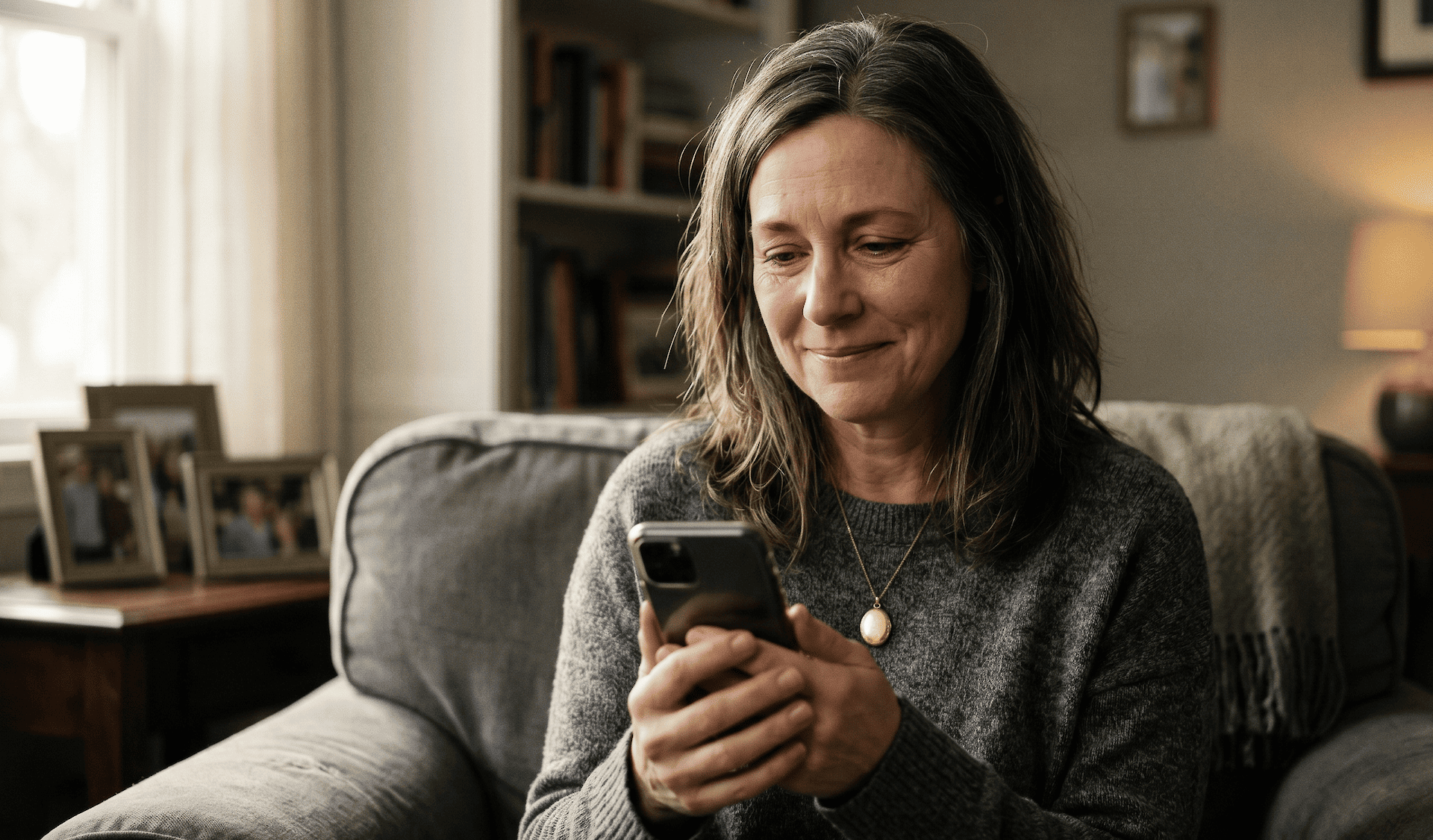
Most bereavement support fails in the same way. You get told about a death, take immediate action by offering a flurry of care packages, cards, and check-ins, and then, almost on a schedule, it stops. Around two to three months in, there is an unspoken expectation to move on. And this tends to happen right when the shock, numbness, and disbelief wear off, and the real grief begins. The people who said “let me know if you need anything” have moved on, just as grief is getting started.
This is the gap that EAPs and health systems quietly inherit. Employees come back to work but aren’t really back because they struggle with presenteeism and absenteeism. Grieving people may start to cycle through the Emergency Department with somatic complaints that turn out to be grief. Employers and health systems tend to provide bereavement support in the form of a packet, a phone number to call, or a time-limited support group, and they call it a robust grief benefit. The people who actually use those services are the ones who are already inclined to seek help. Everyone else?…well, they fall through the cracks.
So what do we do for the people who won’t call the number, attend a support group, or reach out for support? There is a surprisingly good answer, and it has been hiding in plain sight for years.
In the 1970s, a psychiatrist named Jerome Motto started writing letters to patients who had refused follow-up care after a suicide attempt.(1) The letters were short. They didn’t ask for anything. They just let the reader know that he was thinking of them and hoped they were doing okay. He kept sending them consistently, for years.
The result was a measurable reduction in suicides, demonstrated in a randomized trial. The intervention was called Caring Contacts. This intervention has been studied repeatedly and adapted from letters to text messages to modernize the approach.(2) The mechanism remained simple, brief, consistent, non-demanding contact, sustained over time via text message. This approach helped people feel cared for and less alone in a way that substantially improved outcomes. Caring Contacts doesn't involve any assessment, treatment plan, or dosage. And yet it works.
There is a growing body of research suggesting that the brain treats small signals of being thought of as genuinely meaningful. These small signals (in our case, text messages) can provide us with a boost of dopamine, making us feel more connected and motivated to engage in behavior change.(5-7)
Texting works well because it is a medium that people already use. It doesn’t require a grieving person to schedule, drive, log in, or talk on demand, all of which are things that are really challenging when you're grieving. A text shows up, gets read in under a minute, and asks nothing in return. For someone who would never sign up for a support group, that low bar is the entire point.
Bereavement is one of the most predictable event-trigger scenarios where we happen to know the exact moment that risk emerges and for roughly how long the risk remains. The infrastructure to reach and support these people during this major life event already exists in their pocket.
Help Texts is built on this premise. Subscribers receive twice-weekly text messages for as long as they need it, written by grief experts and tailored to their specific loss—who died, how, when, and what role the subscriber played in their life. The messages acknowledge the dates that matter: birthdays, anniversaries, and the death-anniversary, arguably one of the heaviest grief days. A clinical team reviews inbound replies daily and intervenes when someone is in distress, and will provide warm handoffs to crisis lines.
86% of Help Texts subscribers stay enrolled for a full year.(3) And 95% of people who receive our service say that they felt supported in their grief. (3-4) The program also reaches populations that most bereavement services have a hard time engaging with—men, adults over 65, and those living in rural areas.(3-4) Other data suggests that text messages outperform traditional bereavement services when it comes to accessibility, availability, length of service, and effectiveness.(7) None of this is because text messaging is magic. It is because the mechanism is sound and the delivery removes the friction that causes most grief support to go unused.
Most grief benefits are built around a model that people won’t use. Many grieving employees are not going to go back to work and call their EAP's 1-800 number and ask to speak with a counselor. A surviving widower whose wife died is probably not going to drive to a grief group held in a church basement once a month. The utilization rates on these offerings tell the story, and most benefits leaders already know it.
Adding text-based grief support is about providing a lightweight solution that is designed to reach more people and cover the long tail that most services fall short of being able to provide. It is the difference between offering a standard grief benefit (one that looks good on paper, but most won't use) versus providing a service that actually gets used in a sustained way.
Caring Contacts teaches us that small, consistent care, delivered through a channel that meets people where they are, can change outcomes in a meaningful way. Help Texts is doing just that, providing consistent care for the long tail of grief.
To learn how Help Texts is being implemented by EAPs, health systems, hospices, and employers, visit helptexts.com or email info@helptexts.com.
Cited Sources
- Motto, J. A. (1976). Suicide Prevention for High-Risk Persons Who Refuse Treatment*. Suicide and Life-Threatening Behavior, 6(4), 223-230. https://doi.org/10.1111/j.1943-278X.1976.tb00880.x
- Hebert, L. E., Fruhbauerova, M., Evanson, A., Bogic, M., Petras, A., Shaw, J., Muller, C. J., Nelson, L., & Comtois, K. A. (2022). Caring Texts, a strength-based, suicide prevention trial in 5 native communities: Research design and methods. Contemporary Clinical Trials, 123, 106966. https://doi.org/10.1016/j.cct.2022.106966
- Levesque, D. A., Lunardini, M. M., Payne, E. L., & Callison-Burch, V. (2023). Grief Coach, a text-based grief support intervention: acceptability among hospice family members. OMEGA-Journal of Death and Dying, 91(3), 1561-1589.
- Levesque, D. A., Lunardini, M. M., Adams, S. N., Payne, E. L., & Neumann, B. G. (2024). Grief Coach: Feasibility and acceptability of a text message program for bereavement support among grievers in the United Kingdom. Death Studies, 49(4), 391-402.
- Lam, C. (2013). The Efficacy of Text Messaging to Improve Social Connectedness and Team Attitude in Student Technical Communication Projects. Journal of Business and Technical Communication. https://doi.org/10.1177/1050651912468888
- Suffoletto, B. (2016). Text message behavioral interventions: From here to where? Current Opinion in Psychology, 9, 16-21. https://doi.org/10.1016/j.copsyc.2015.09.012
- Small, G. and Vorgan, G. (2008). iBrain: Surviving the Technological Alteration of the Modern Mind, New York: HarperCollins.
- Lunardini, M., Levesque, D. Comparing user satisfaction with grief-informed texts to other types of bereavement support in the United Kingdom. BMC Public Health (2026). https://doi.org/10.1186/s12889-026-27605-9