
Ninety-four percent of Help Texts subscribers are matched with resources specific to their loss. That’s on top of the full year of tips and suggestions we text straight to their phones. That 94% reflects something real about how support should work for grieving people.
Finding the right resources when you are grieving is hard
Grief brain is real. When someone is newly bereaved, they are often too overwhelmed to sift through search results or evaluate credibility. And with AI-generated summaries now shaping most Google searches, the "top" resources served to a griever may not be what a clinician would recommend at all.
That gap costs people time and energy. Often it also makes it hard for grieving people to trust in the idea that meaningful support exists for them.
The myth we hear from almost every newly bereaved person
"There is nothing out there for me."
We hear this constantly. In reality, there is no shortage of grief resources. There are books, podcasts, support groups, workbooks, community organizations, self-help, articles, blogs, research, checklists, texting programs, and much more. Locating the right one for the right person at the right moment is the real challenge.
That is where matching comes in.
How Help Texts matches subscribers to resources
Every resource we recommend is vetted by our clinical team, each of whom is a thanatologist with many years’ of experience supporting grieving people through every kind of loss. They know what is credible. More importantly, they’re incredibly good at knowing what resources to recommend, when to recommend them, and for whom they’re most likely to resonate.
Many of these resources come directly from Help Texts’ network of expert contributors — world-leading voices on grief and loss whose work spans blogs, books, podcasts, support groups, retreats, conferences, and online communities. Others are nationally recognized resources that thanatologists trust and recommend.
When it comes to resources, some grievers want edgy and irreverent. Others want tender and reflective. Some want checklists. Some want a memoir. Some need a community. Some need a private self-help or text-based option. Grief resources are not one-size-fits-all, and matching honors that.
With Help Texts, some resources arrive via text. Others live in the subscriber's portal, hand-selected for them by our clinical team.
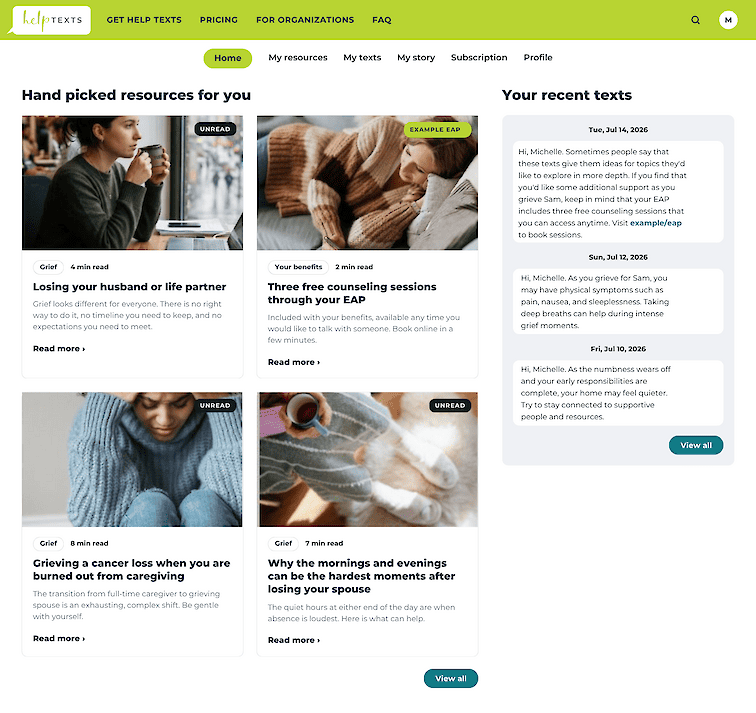
The research is on our side
Proactive human-led resource navigation — connecting people directly to services rather than expecting them to find their own way — is one of the most effective ways to link individuals to the care they need. Research shows that having a human-led resource navigator to a person's care improved satisfaction and increased access to services across a wide range of settings.1
That is exactly what Help Texts does proactively and at scale.
Why this matters for your organization
For employers and EAPs the ability to drive benefit utilization is a real differentiator. For hospices and healthcare providers, being able to direct people to appropriate resources that they’ll actually use is a game changer. It shows the people you serve that someone thought about them specifically, and that the support they receive was hand-picked with their unique loss in mind. That is a powerful outcome and for many organizations, it is what turns a benefit or service into something people actually use, remember, and recommend.
Contact us to learn more about how Help Texts can serve the people you serve.
Source
- Parish, W., Beil, H., He, F., D'Arcangelo, N., Romaire, M., Rojas-Smith, L., & Haber, S. G. (2023). Health Care Impacts Of Resource Navigation For Health-Related Social Needs In The Accountable Health Communities Model. Health affairs (Project Hope), 42(6), 822–831. https://doi.org/10.1377/hlthaff.2022.01502